
Article
Do AI SDRs Actually Work? The Answer Might Surprise You...
Nov 30, 2025
Do AI SDRs actually work?
The short answer: yes—but not the way most vendors sell them.
The AI SDR market is exploding. It's worth $4.12 billion today and projected to reach $15 billion by 2030. Every founder I talk to is either buying an AI SDR, building one in-house, or wondering if they should.
But here's the uncomfortable truth: 42% of companies are abandoning their AI SDR implementations, up from just 17% last year.
I've spent the last 8 months building AI SDR systems for B2B companies. I've seen the wins. I've seen the spectacular failures. And I've learned that the companies succeeding with AI SDRs are doing something completely different than what the vendors are selling.
Do AI SDRs actually work?
The short answer: yes—but not the way most vendors sell them.
The AI SDR market is exploding. It's worth $4.12 billion today and projected to reach $15 billion by 2030. Every founder I talk to is either buying an AI SDR, building one in-house, or wondering if they should.
But here's the uncomfortable truth: 42% of companies are abandoning their AI SDR implementations, up from just 17% last year.
I've spent the last 8 months building AI SDR systems for B2B companies. I've seen the wins. I've seen the spectacular failures. And I've learned that the companies succeeding with AI SDRs are doing something completely different than what the vendors are selling.
If you're evaluating AI SDR tools right now, or if you already bought one and it's not working, this is what you need to know.
(Here's the full breakdown of why most implementations fail if you want to skip ahead.)
The Problem With AI SDR Hype Right Now
Let me show you what's happening.
What every AI SDR vendor promises:
"Replace your entire SDR team"
"10x your pipeline on autopilot"
"Our AI learns your ICP automatically"
"Book 50+ meetings per month with zero effort"
"Set it and forget it"
What actually happens:
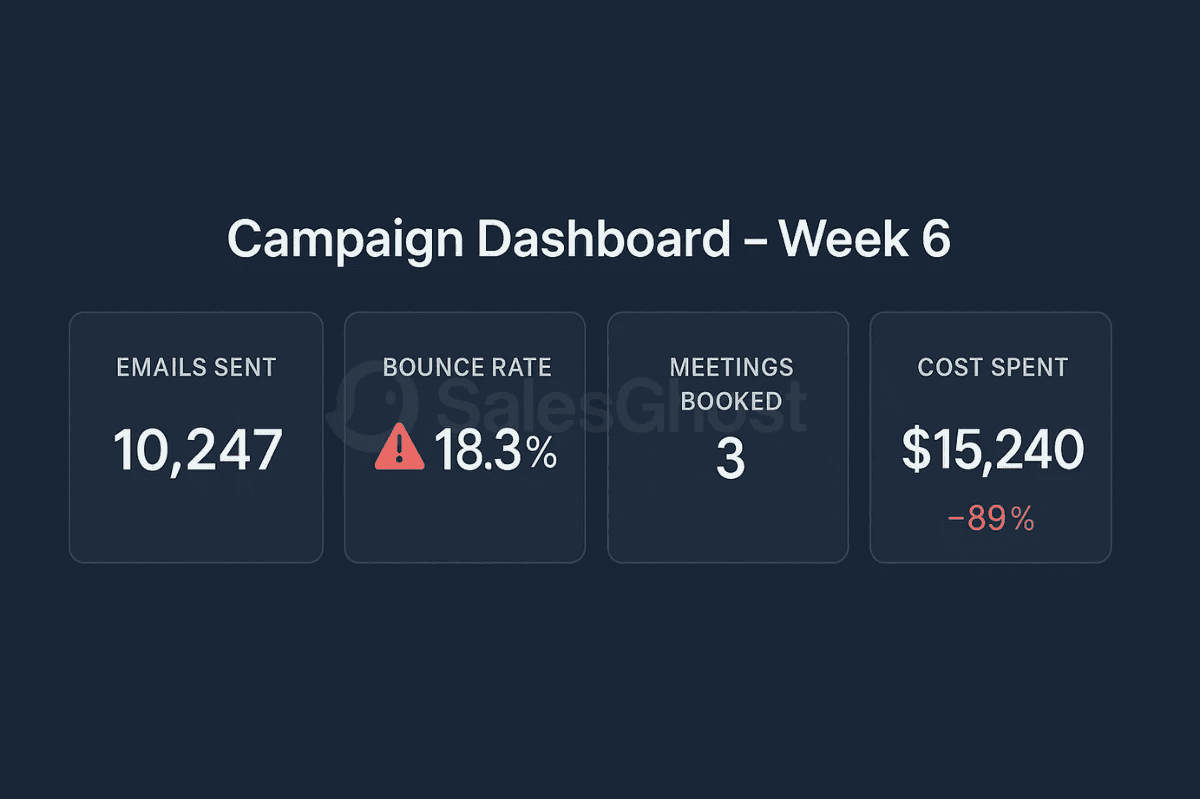
A B2B SaaS company I talked to last month bought an AI SDR platform. They loaded 5,000 leads. Hit go. Waited for meetings.
Six weeks later:
10,000 emails sent
18% bounce rate
Domain reputation destroyed
3 meetings booked
$15K burned
The founder called me and said: "AI SDRs don't work."
Wrong. The AI SDR worked fine. It did exactly what it was told to do: blast emails at everyone with "VP Sales" in their title.
The problem? Nobody told the AI who to actually target.
This is happening everywhere. Companies buy AI SDRs thinking they're autonomous. They're not. They're amplifiers.
And if you amplify a broken strategy, you just break things faster.
Why 42% of AI SDR Implementations Fail (And How to Avoid It)
The average organization scraps 46% of AI proof-of-concepts before they ever go live.
Here's why:
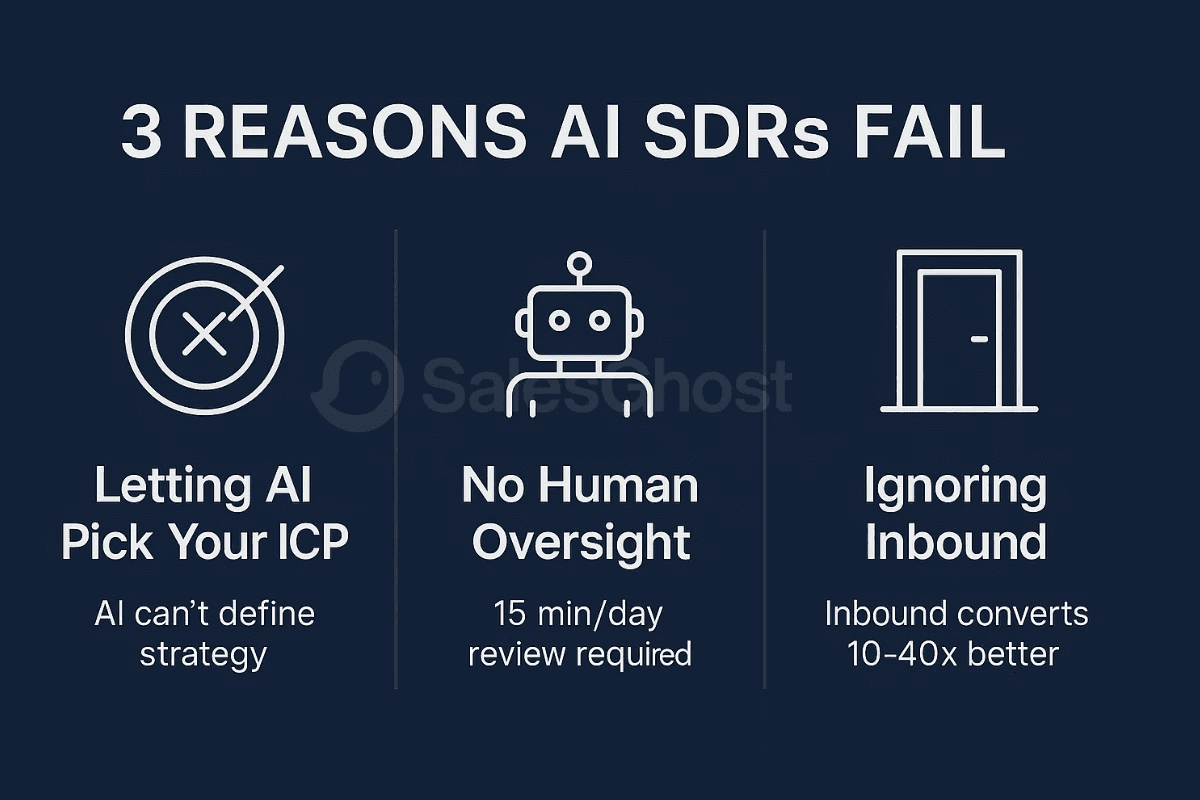
Mistake #1: Letting AI Pick Your ICP
I see this constantly.
Founder buys AI SDR. Implementation team asks: "What's your ICP?"
Founder says: "Can't the AI figure that out?"
No. It can't.
AI is phenomenal at execution. Terrible at strategy.
It can send 1,000 personalized emails per day. But it cannot identify the patterns in your closed deals. It doesn't know that your best customers are Series B SaaS companies with 100-500 employees who just raised funding and use Salesforce + Outreach.
You have to tell it that.
When you don't, the AI does what it's programmed to do: find everyone with a relevant title and start sending.
Result? Spray and pray at scale. Damaged sender reputation. Burned leads. Wasted budget.
Mistake #2: No Human Oversight
Here's what vendors won't tell you: AI SDRs need daily management.
Not babysitting. But strategic checkpoints.
Example:
A prospect replies: "This sounds interesting but we're in the middle of a huge project. Can we revisit in Q2?"
AI classification: Not Interested
Action: Suppressed from outreach.
Result: $50K deal lost because the AI can't read nuance.
A human SDR sees that reply and thinks: "Perfect timing. I'll follow up January 15th."
The companies crushing it with AI SDRs? They have a human review flagged replies for 15 minutes every morning.
One company found 12 hidden opportunities in the first week that the AI would've suppressed. That's $50K+ in pipeline from 15 minutes of work.
Mistake #3: Ignoring Inbound
Most companies only automate outbound.
Huge mistake.
Inbound leads convert 10-40x higher than cold outbound.
Demo requests convert at 75-80%. Cold emails convert at 1-3%.
But 80% of companies take longer than 5 minutes to respond to demo requests.
Meanwhile, leads contacted within 5 minutes are 21x more likely to convert.
AI SDRs never sleep. They can respond in 30 seconds. Book the meeting. Update your CRM. All while your human SDRs are in bed.
A B2B company I worked with had a 4-hour average response time. Demo-to-meeting conversion: 42%.
We added AI SDR for inbound. Response time dropped to 45 seconds. Conversion jumped to 78%.
Same cost. 85% more meetings.
If you're only using AI for cold outbound, you're leaving massive pipeline on the table.
TL;DR: Why Most AI SDRs Fail
AI can't define your ICP
AI needs daily human oversight (15 min/day)
Inbound automation matters more than outbound
AI amplifies bad strategy faster than humans
Real Example of What Actually Works
Let me show you the flip side.
Different company. Same size. Same industry. Completely different outcome.
What they did:
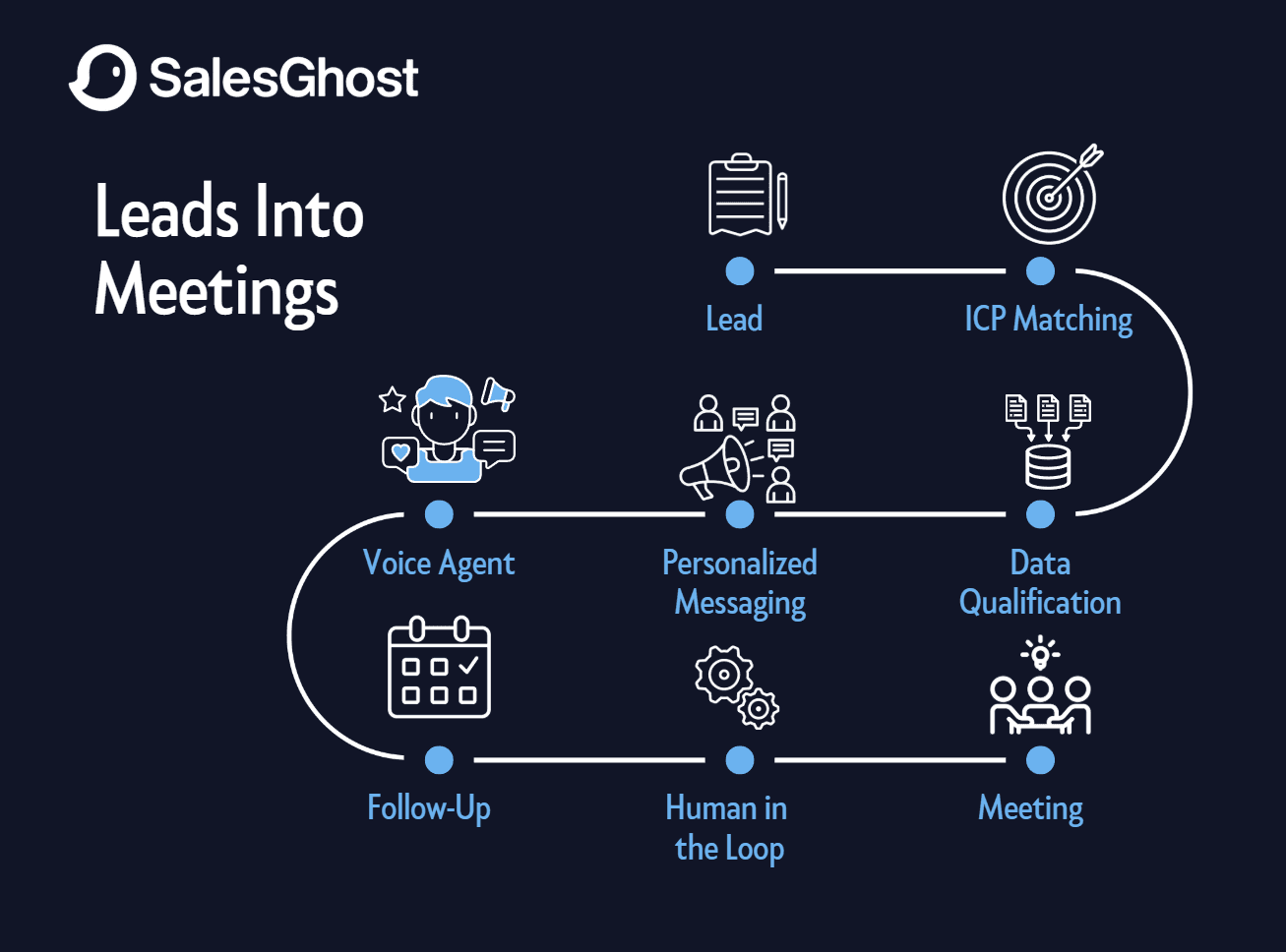
Week 1-2: They Defined Strategy First
Pulled last 50 closed deals. Found patterns:
Company size: 100-500 employees
Industries: SaaS, fintech
Titles: VP Sales, CRO, Head of Revenue
Tech stack: Salesforce + Outreach (outbound maturity signal)
Funding: Series B or later
They didn't ask AI to "find customers." They told it exactly who to target.
Week 3: They Tested Before Scaling
Wrote 3 email variations. Sent manually to 30 prospects. Tracked replies.
Found a winner: 11% reply rate (vs. 2-4% industry average).
Then they gave it to the AI.
Week 4-8: They Deployed With Oversight
AI sent 25 emails/day (not 200)
Human reviewed replies daily (15 min)
Caught opportunities AI would've missed
Results After 60 Days:
47 meetings booked
Zero deliverability issues
8 opportunities created
2 deals closed ($48K total)
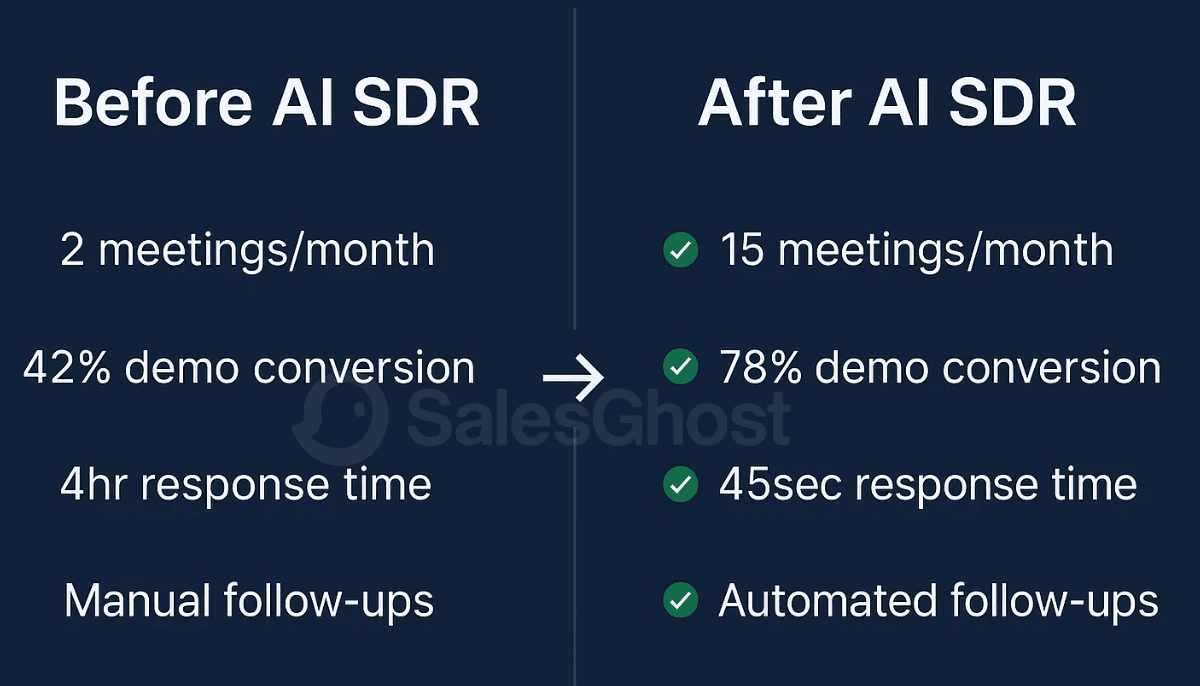
Same technology. Completely different result.
The difference?
They treated AI like an SDR. Not a magic box.
SDRs need direction. Coaching. Oversight.
AI is no different.
The Human-in-the-Loop Framework for AI SDR Success
Here's what the successful companies do:
Daily (15 minutes)
Reply Review
AI flags all replies. Human reviews anything marked "positive" or "neutral."
Why? AI misses nuance. That "not right now" might be a Q2 opportunity.
Meeting Confirmations
Human adds personal touch. "Looking forward to our call Thursday!"
Small detail. Massive impact on show rates.
Weekly (30 minutes)
Message Quality Control
Review 10 AI-generated emails. Are they good? Are they cringe?
Adjust prompts if needed.
Performance Analysis
What's the reply rate? Positive share? Meeting book rate?
If something's off, dig in.
Monthly (1 hour)
Full Review
Total performance. What's working? What's not?
Update ICP targeting. Refresh messaging. Optimize sequences.
Cost Analysis
Are you getting ROI? Cost per meeting? Cost per opportunity?
AI SDRs should be profitable. If they're not, something's broken.
When AI SDRs Make Sense (And When They Don't)
AI SDRs Work Best For:
✅ High-volume outbound - Sending 100+ emails/day
✅ Speed-to-lead - Instant inbound response
✅ Consistent follow-up - Never miss a touchpoint
✅ Data-driven targeting - Clear ICP with buying signals
✅ Multi-channel sequences - Email + LinkedIn + calls
AI SDRs Struggle With:
❌ Complex enterprise sales - Long cycles, multiple stakeholders
❌ Relationship-heavy deals - Trust-building over months
❌ Undefined ICP - "We sell to everyone"
❌ Poor data quality - Garbage in, garbage out
❌ Set-it-and-forget-it mindset - AI needs management
AI SDR vs Human SDR: The Real Comparison
Let me kill a myth: AI SDRs don't replace human SDRs.
They change what humans do.
What AI Does Better:
Volume: Send 1,000+ emails/day (humans: 50-100)
Speed: Respond in 30 seconds (humans: hours/days)
Consistency: Never misses a follow-up
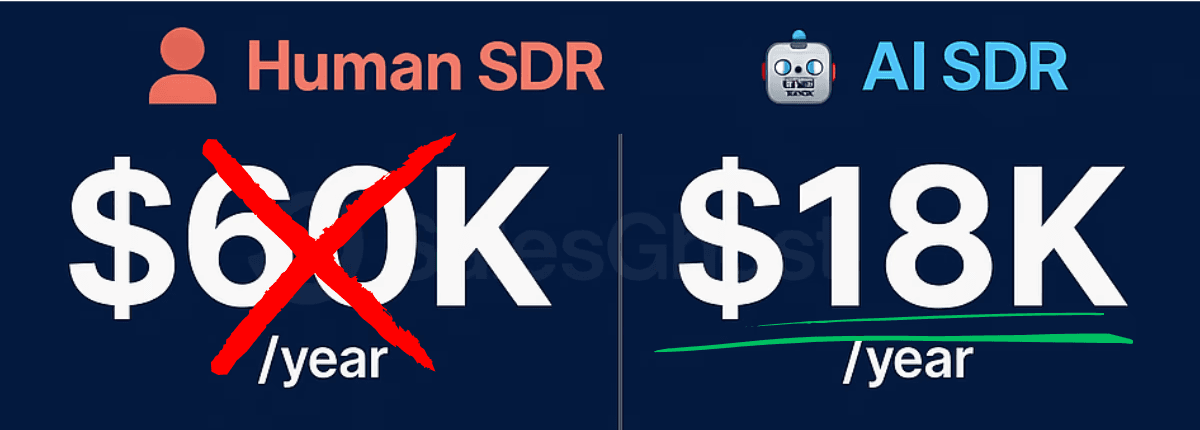
Cost: $1K-5K/month (human: $60K/year)
What Humans Do Better:
Strategy: Define ICP from closed deals
Nuance: Read between the lines on replies
Relationships: Build trust over time
Complex discovery: Multi-stakeholder conversations
Closing: Turn conversations into revenue
The Winning Formula:
AI handles: Research, outreach, follow-ups, booking
Humans handle: Strategy, nuance, relationships, closing
Companies trying to go 100% AI? Failing.
Companies using AI to amplify human SDRs? Crushing it.
How to Implement AI SDRs Successfully: Step-by-Step
If you're going to do this, do it right:
Step 1: Define Your ICP (Don't Skip This)
Pull your last 50 closed deals.
Find patterns:
Company size
Industry
Titles
Tech stack
Pain points
Disqualifiers
Document it. This is your targeting bible.
Step 2: Test Messaging Manually First
Write 3 email variations. Send to 30 prospects by hand.
Track replies. Find what works.
Get to 8%+ reply rate before you automate.
If you can't hit that manually, AI won't save you.
Step 3: Start Small, Scale Slow
Week 1: 10 emails/day
Week 2: 25 emails/day
Week 3: 50 emails/day
Watch deliverability. Watch reply rates.
If something breaks, you catch it early.
Step 4: Build Human Checkpoints
Daily: 15 min reply review
Weekly: 30 min quality check
Monthly: 1 hour full review
AI SDRs need management. Plan for it.
Step 5: Automate Inbound Too
Don't just do cold outbound.
Add AI for:
Demo request response (30-second callbacks)
Lead qualification
Meeting booking
Follow-up sequences
Inbound converts 10-40x better. Automate it first.
The Bottom Line on AI SDRs
Here's the truth:
AI SDRs work. But not how vendors sell them.
They're not autonomous. They're not plug-and-play. They're not a replacement for strategy.
They're amplifiers.
Give them a good strategy, good oversight, good data? They'll 10x your output.
Give them garbage? They'll amplify that too.
The companies winning with AI SDRs right now aren't the ones with the fanciest tools.
They're the ones with the clearest ICP, the tightest messaging, and the discipline to manage the AI daily.
Want the full breakdown? Download our guide on the 3 biggest AI SDR mistakes (7 min read).
Want help building this?
If your AI SDR is already booked, installed, and still not delivering meetings—that's not a tool problem. It's an implementation problem.
We help B2B teams deploy AI SDR systems that actually book meetings. First 3 meetings free. You only pay after we prove it works. Book a strategy call.
FAQ: AI SDR Tools
What is an AI SDR?
An AI SDR (Artificial Intelligence Sales Development Representative) is software that automates early-stage sales tasks: prospecting, outreach, reply handling, and meeting booking. Think of it as an SDR that works 24/7, never forgets a follow-up, and can handle hundreds of leads simultaneously.
Do AI SDRs actually work?
Yes—but only with proper implementation. 58% of companies see success when they: (1) define ICP before deploying, (2) test messaging manually first, (3) maintain human oversight, and (4) automate both outbound AND inbound. The 42% who fail skip these steps.
How much do AI SDR tools cost?
Most AI SDR platforms run $1K-$10K/month depending on volume and features. Compare that to a human SDR at $60K/year. But remember: cheap AI SDR + bad strategy = wasted money. Expensive AI SDR + good strategy = ROI.
What are the best AI SDR tools?
Top platforms include 11x.ai, Artisan, AiSDR, Clay (for enrichment), and Apollo (for data). But the "best" tool depends on your use case. High-volume outbound? Different tool than speed-to-lead inbound. We help companies pick the right stack for their motion.
Can AI SDRs replace human SDRs?
No. AI handles volume, speed, and consistency. Humans handle strategy, nuance, and relationships. The winning formula: AI for research + outreach + booking. Humans for ICP definition + complex discovery + closing.
How long does AI SDR implementation take?
Done right? 4-8 weeks. Week 1-2: ICP definition + data cleanup. Week 3: Manual testing. Week 4-6: Gradual deployment with monitoring. Week 7-8: Optimization. Companies who rush this blow up their domain reputation in 30 days.
What's the ROI of an AI SDR?
Depends on execution. Good implementation: 3-5x ROI in 90 days. One client went from 2 meetings/month to 15/month with same team size. Cost: $3K/month. Value: $48K in new pipeline in 60 days. That's 16x ROI.
Last updated: December 2025 | SalesGhost