
Resources
Why Marketing-Generated Leads Fail in Sales
Jan 12, 2026
Most B2B marketing teams don’t struggle with lead generation.
They struggle with lead quality, sales handoff, and conversion to pipeline.
Leads come in. CRMs fill up. Dashboards look healthy. But once those marketing-generated leads reach sales, momentum drops. Follow-up slows. Deals stall.
The root issue usually isn’t volume.
It’s qualification and context.
(And How Pre-Qualification Fixes the Lead Quality Problem)
Most B2B marketing teams don’t struggle with lead generation.
They struggle with lead quality, sales handoff, and conversion to pipeline.
Leads come in. CRMs fill up. Dashboards look healthy. But once those marketing-generated leads reach sales, momentum drops. Follow-up slows. Deals stall.
The root issue usually isn’t volume.
It’s qualification and context.
The marketing and sales lead qualification gap
Marketing and sales are measured on different outcomes.
Marketing teams are typically responsible for:
Lead generation
Cost per lead (CPL)
MQL volume
Campaign performance
Sales teams are responsible for:
Qualified pipeline
Deal velocity
Revenue
Forecast accuracy
That difference creates friction.
A lead that qualifies as an MQL may still:
Lack buying intent
Be early-stage research
Have no urgency or budget
Not be the real decision maker
Be unclear on the actual problem
From sales’ perspective, these leads feel unqualified — even if they technically meet marketing criteria.
The hidden cost of poor lead quality
When sales has to re-qualify every marketing lead, several problems emerge:
1. Slower speed to lead
Reps delay follow-up because past experience suggests many leads won’t convert.
2. Lost context
Sales doesn’t know what triggered the lead’s interest, what problem they’re solving, or why they engaged.
3. Breakdown in trust
Sales teams begin to discount marketing-generated leads entirely.
These issues rarely show up in reports, but they show up clearly in pipeline performance and win rates.
Why most agencies don’t solve this problem
Many demand generation agencies optimize for top-of-funnel metrics because that’s what they’re measured on.
What’s often missing:
Quota-carrying sales experience
Understanding of real sales qualification
Familiarity with objections and buying signals
Accountability beyond lead delivery
As a result, leads are passed to sales too early.
What pre-qualification actually means
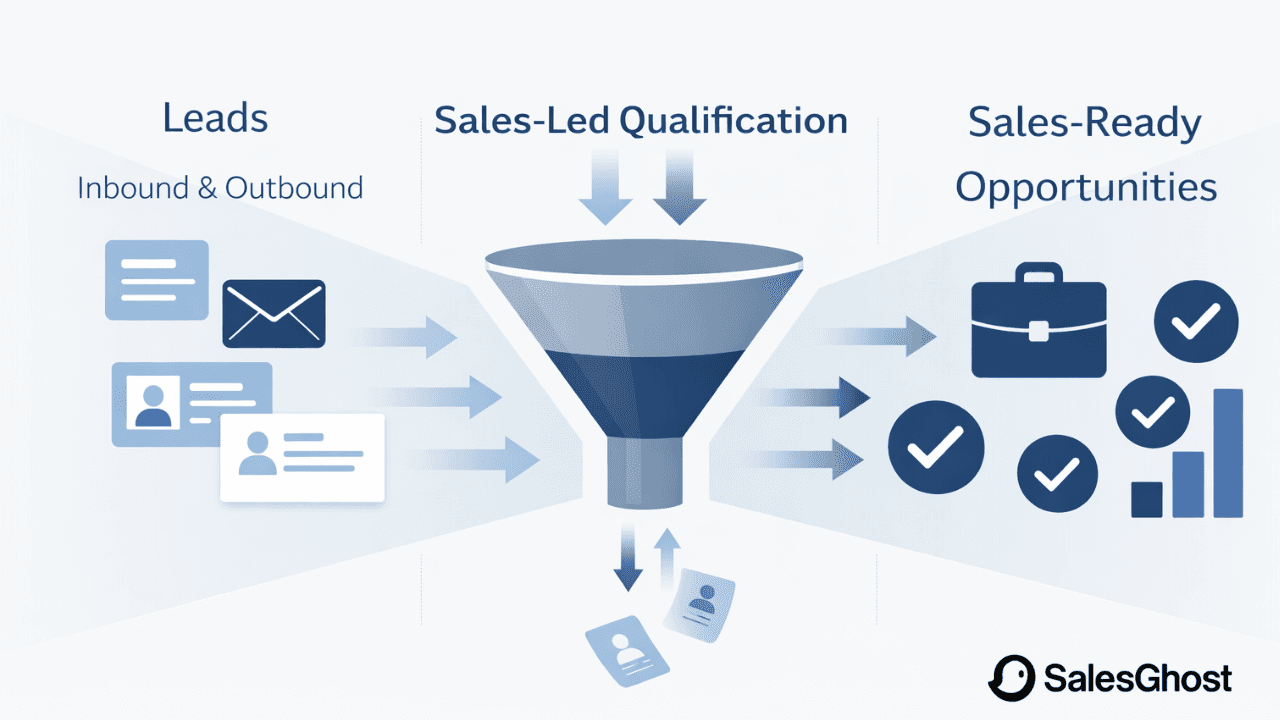
Pre-qualification sits between marketing and sales.
Instead of sending every lead directly to sales, leads are:
Contacted quickly
Asked a short set of sales-oriented questions
Evaluated for intent, urgency, and fit
Documented with notes and context
Only qualified leads are then routed to sales.
This improves:
Sales efficiency
Lead-to-opportunity conversion
Alignment between marketing and sales
Trust in marketing-sourced pipeline
Why sales experience matters in lead qualification
Effective pre-qualification requires people who understand sales.
That means knowing:
What real buying intent sounds like
When to disqualify respectfully
How to surface objections early
What information sales actually needs to progress a deal
Without sales experience, qualification becomes a checklist.
With it, leads arrive ready for real conversations.
What high-performing marketing teams do differently
Strong B2B marketing teams focus less on lead volume and more on:
Speed to contact
Lead intent validation
Clean sales handoff
Revenue impact, not just MQLs
The result:
Fewer leads, more pipeline
Faster deal cycles
Better marketing credibility with sales leadership
Final takeaway
If sales is constantly re-qualifying marketing leads, the system isn’t broken — it’s incomplete.
Pre-qualification isn’t added friction.
It’s waste removal.
When marketing and sales meet in the middle, lead generation turns into pipeline — and pipeline turns into revenue.